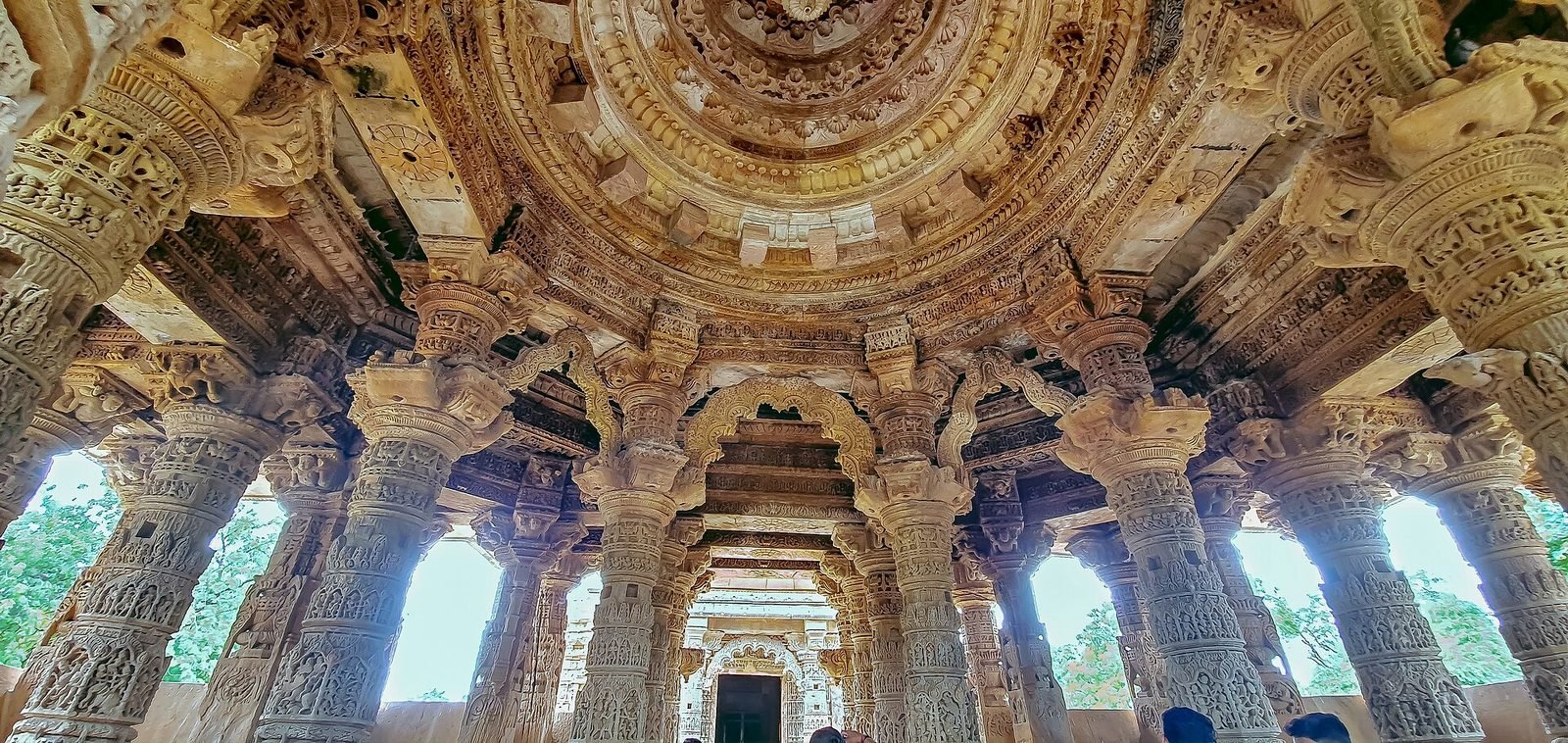
Set in Modhera, Gujarat, Modhera Sun Temple is dedicated to Surya (the Sun God). It is also known as Surya Mandir, Modhera.
The temple is renowned for its astronomical alignment: the first rays of the rising sun illuminate the image of Surya during the equinoxes, and at the summer solstice the sun shines directly overhead at noon. It is a Monument of National Importance protected by the Archaeological Survey of India and was added to UNESCO's tentative World Heritage list in December 2022. The temple was built in 1026-27 CE during the reign of Bhima I of the Chaulukya dynasty.
Gujarat carries a distinct temple identity of its own: Gujarat's sacred coast and hills hold the first Jyotirlinga at Somnath, Krishna's kingdom at Dwarka, a Shakti Peeth at Ambaji and the temple-crowned heights of Girnar.
Darshan hours and daily worship
| Session | Timing (as published) |
|---|---|
| Morning | 7:00 AM - 6:00 PM (continuous, monument open hours, not divided into morning/evening darshan sessions) |
No worship is currently offered at the temple; it functions as an ASI-protected archaeological monument, not an active place of daily worship, so these are site open hours rather than darshan timings. The adjoining site museum keeps separate hours, roughly 10:00 AM - 5:00 PM, and is closed on Fridays, per third-party travel sources (not independently confirmed on an official ASI page).
Festivals and special-day timings
Regular darshan hours are usually extended, or set aside entirely, on these dates.
| Festival | Period | What happens |
|---|---|---|
| Modhera Dance Festival (Uttarardh Mahotsav) | Three days in the third week of January, timed just after Uttarayan/Makar Sankranti | An annual classical dance festival organized by the Gujarat Tourism Corporation, held against the backdrop of the Sun Temple, featuring performers of Bharatanatyam, Kuchipudi, Kathak and other classical Indian dance forms from across the country. |
History and architecture
Architecture
Maru-Gurjara (Solanki-era) style. The complex has three parts: the Suryakund, a large rectangular stepped tank with 108 miniature shrines; the Sabha Mandap (assembly hall) with 52 carved pillars depicting scenes from the Ramayana and Mahabharata; and the Guda Mandap (main shrine hall) with the sanctum. Sandstone carvings include the 12 Adityas (monthly aspects of Surya), Ganesha, Kubera, and the eight Dikpals.
History
The temple was built in 1026-27 CE during the reign of Bhima I of the Chaulukya dynasty. An inscription dated Vikram Samvat 1083 suggests the temple was destroyed and reconstructed, possibly linked to Mahmud of Ghazni's invasion of the region in 1024-25 CE. The assembly hall was added later during the reign of Karna I in the third quarter of the 11th century.
Planning your visit
How to reach
By road: about 26 km from Mehsana, 83 km from Gandhinagar, and 99 km from Ahmedabad. By rail: nearest railway station is Mehsana Junction, roughly 26-28 km away (about 40 minutes by road). By air: nearest airport is Sardar Vallabhbhai Patel International Airport, Ahmedabad, roughly 95-102 km away.
Where this information comes from
Confidence: Medium. History, architecture, astronomical significance, ASI protection status, and festival details are well corroborated between Wikipedia and Gujarat Tourism's official site. However, exact current entry fee and museum hours could not be confirmed on an official ASI page (only via third-party travel/ticketing sites), so those two fields are flagged as indicative rather than certain. As an ASI monument with no active worship, standard darshan-style timings do not apply here; only general site open hours are given.