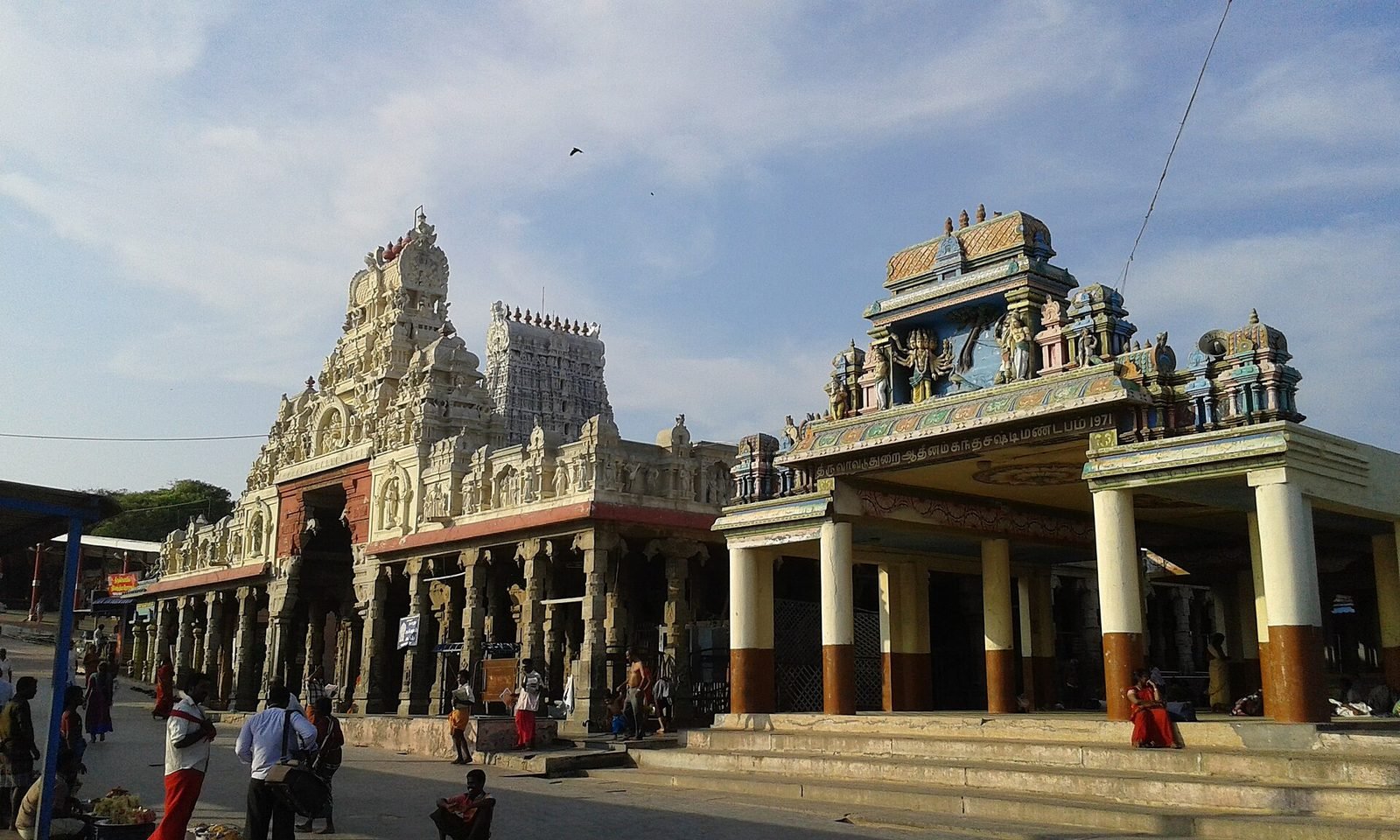
In Thiruchendur, Tamil Nadu, Thiruchendur Murugan Temple (Arulmigu Subramaniya Swamy Temple) honours Lord Murugan (Subramaniya Swamy), worshipped as Senthilandavar and, in his victor form, Jayanthinathar, with shrines to his consorts Valli and Deivanai. It is also known as Tiruchendur Murugan Temple; Senthilandavar Temple; Thiruchieralaivai.
One of the six major Murugan abodes (Arupadai Veedu) and one of the most visited Murugan temples in Tamil Nadu. The Skanda Sashti festival, which marks Murugan's victory over Surapadman, is celebrated here every year. The temple is also known for the pannir ilai vibhuti (leaf-wrapped sacred ash) given as prasad, which the temple's own history page links to Adi Shankara's composition of the Subrahmanya Bhujangam. The temple is described by its administration as the second of the six Arupadai Veedu (abodes of Murugan), and the place was known in early Tamil literature as Thiruchieralaivai.
Tamil Nadu carries a distinct temple identity of its own: Land of towering gopurams and living Dravidian temple traditions, from the Chola masterpieces to the great Pancha Bhoota Sthalas.
Darshan hours and daily worship
| Session | Timing (as published) |
|---|---|
| Morning | 4:00 AM - 9:00 PM (open continuously) |
From the HR&CE temple page: 'Temple Open From 04:00 A.M to 09:00 P.M Continuously. Temple opening time will be changed on festival days.' Festival-day variations quoted there: Margazhi month 3:00 AM to 8:00 PM; Vaikasi Visakam 1:00 AM to 9:00 PM; first and seventh day of the Masi and Avani festivals 1:00 AM to 9:00 PM, other days of those festivals 3:00 AM to 9:00 PM; first and sixth day of Kantha Sashti 1:00 AM to 9:00 PM; Thai Poosam 1:00 AM to 9:00 PM; Panguni Uthiram 4:00 AM to 9:00 PM. The page lists a 9:00-9:05 PM closing interval and states queue cut-offs: free queue up to 7:30 PM, paid darshan queues close at 6:30 PM, senior queue 6:00 AM to 7:00 PM, all 'subject to administrative changes'. The page's morning and evening fields share the noon boundary, but they agree with its continuous 4:00 AM to 9:00 PM statement.
Poojas and daily rituals
The HR&CE page lists the following daily poojas: Thirukkappu (opening), Subrabhadham, Viswaroopa, Kalasandhi, Uchikkala, Sayaraksha (evening), Palliyarai and Thirukkappu (closing). Its temple fee table also lists paid services such as Abishekam and Shanmugar Archanai.
Daily aarti and pooja schedule
| Ritual | Time |
|---|---|
| Thirukkappu (Opening) | 4:00 AM (page lists 4:00 AM to 4:00 AM) |
| Subrabhadham Pooja | 5:10 AM - 5:25 AM |
| Viswaroopa Pooja | 5:30 AM - 5:35 AM |
| Kalasandhi Pooja | 8:00 AM - 8:30 AM |
| Uchikkala Pooja | 12:00 PM - 12:15 PM |
| Sayaraksha Pooja (Evening) | 5:00 PM - 5:15 PM |
| Palliyarai Pooja | 8:45 PM - 9:00 PM |
| Thirukkappu (Closing) | 9:00 PM - 9:05 PM |
Festivals and special-day timings
Regular darshan hours are usually extended, or set aside entirely, on these dates.
| Festival | Period | What happens |
|---|---|---|
| Kantha Sashti (Skanda Sashti) and Soorasamharam | Tamil month of Aippasi (October-November) | The temple's biggest festival, re-enacting Murugan's victory over Surapadman; the temple opens at 1:00 AM on the first and sixth days. |
| Vaikasi Visakam | Tamil month of Vaikasi (May-June) | Murugan's birth star festival; the temple opens at 1:00 AM. |
| Thai Poosam | Tamil month of Thai (January-February) | A major Murugan festival; the temple opens at 1:00 AM. |
| Masi and Avani festivals | Tamil months of Masi (February-March) and Avani (August-September) | Annual festivals with earlier opening hours, 1:00 AM on the first and seventh days. |
| Panguni Uthiram | Tamil month of Panguni (March-April) | An annual festival day, with the temple opening at 4:00 AM. |
History and architecture
Architecture
A seashore temple on the Bay of Bengal, entered through a nine-storey gopuram about 157 feet (48 m) high. The sanctum is described as lying in a cave-like setting, and the complex has enclosing corridors (prakarams) and many sub-shrines, including Shanmugar, Valli, Deivanai, Natarajar and a Panchalingam shrine behind the main sanctum. The temple also lists a Valli cave and the Nazhi Kinaru well among its specialities.
History
The temple is described by its administration as the second of the six Arupadai Veedu (abodes of Murugan), and the place was known in early Tamil literature as Thiruchieralaivai. Tradition holds that Murugan camped here and defeated the demon Surapadman, an event re-enacted every year as Soorasamharam. Historical accounts say the Dutch East India Company occupied the complex from 1646 to 1648, carried off two processional idols and lost them at sea, and that the idols were recovered in 1653. The temple is now run by the Hindu Religious and Charitable Endowments (HR&CE) Department of the Government of Tamil Nadu.
Planning your visit
Darshan types and fees
| Type | Price | Notes |
|---|---|---|
| Free Queue Line | Free | HR&CE page: permitted up to 7:30 PM, subject to administrative changes |
| Maniyadi viraivu darshan (paid queue) | Rs 100 | Amount from the HR&CE fee table (currency not printed); paid darshan queues close at 6:30 PM per the same page |
| Senior Queue Line | Not stated | HR&CE page: senior queue darshan from 6:00 AM to 7:00 PM |
How to reach
The temple is in Tiruchendur town, Thoothukudi district (PIN 628215), on the Bay of Bengal shore. The HR&CE location page lists the temple's own bus stand at 0.1, the Tiruchendur bus stand at 1.2, Tiruchendur railway station at 1.5, Thoothukudi airport at 45 and Thoothukudi bus stand at 40 (the page prints no unit; kilometres assumed).
Where this information comes from
Confidence: High. Hours, daily pooja times, queue cut-offs and fees are taken from the temple's own HR&CE (Government of Tamil Nadu) site, which shows its structured fields and its free text agreeing on 4:00 AM to 9:00 PM; minor quirks are an opening pooja listed as 4:00 AM to 4:00 AM and a noon boundary shared by both fields. Dutch-occupation history comes from Wikipedia, and festival months are the standard Tamil calendar months.
- tiruchendurmurugan.hrce.tn.gov.in
- tiruchendurmurugan.hrce.tn.gov.in
- tiruchendurmurugan.hrce.tn.gov.in
- tiruchendurmurugan.hrce.tn.gov.in
- tiruchendurmurugan.hrce.tn.gov.in
- tiruchendurmurugan.hrce.tn.gov.in
- en.wikipedia.org