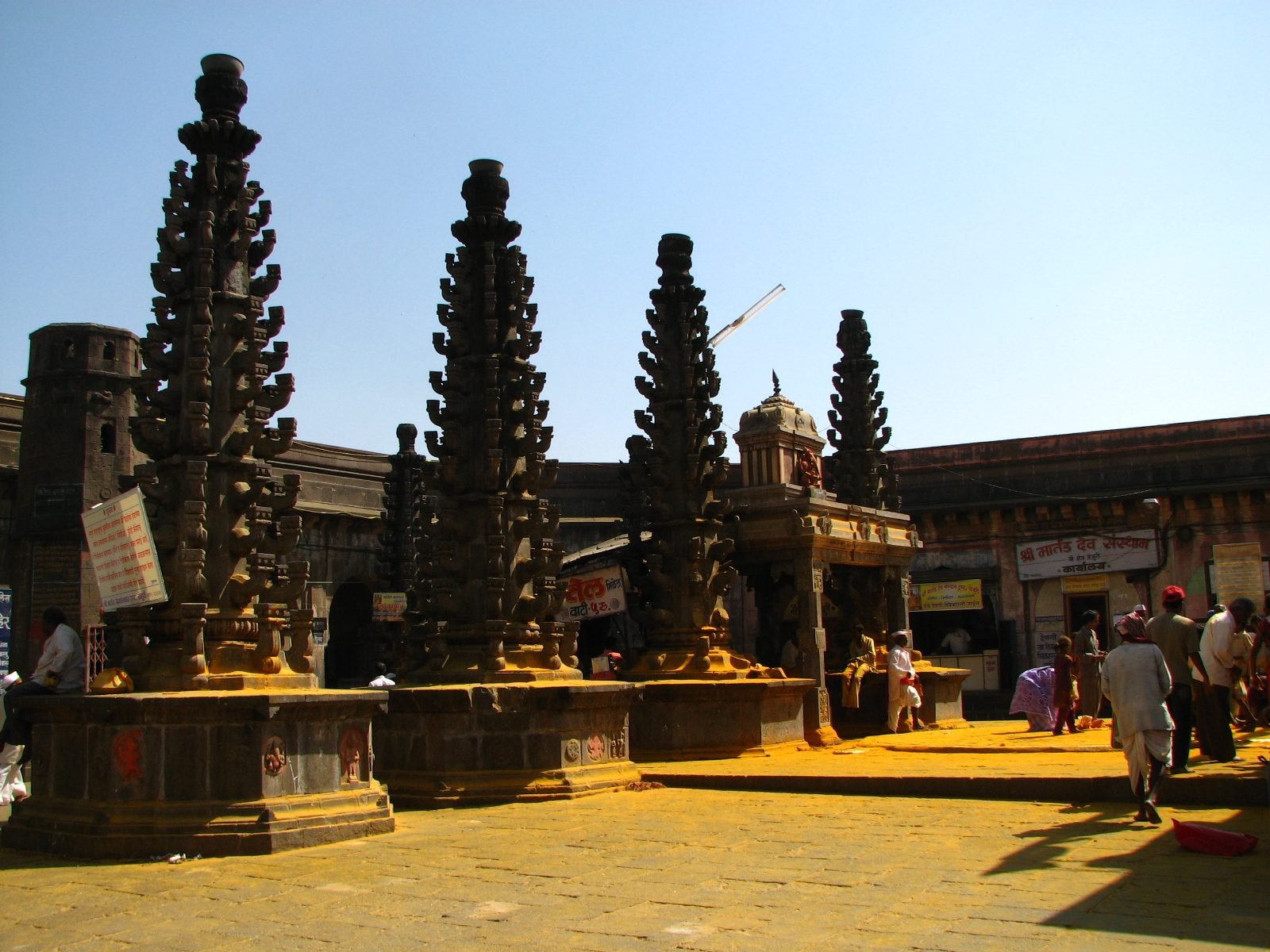
Set in Jejuri, Maharashtra, Khandoba Temple, Jejuri is a shrine to Khandoba (also known as Mhalsakant, Malhari Martand or Mylaralinga), regarded as a form of Shiva. It is also known as Jejuri Gad, Shri Khandoba Mandir, Malhari Martand Temple.
Though Khandoba is worshipped at numerous temples across Maharashtra and Karnataka, the Jejuri temple is considered the foremost and most important of them, and Khandoba is a kuladevata (family deity) for many Maharashtrian communities, especially warrior, farming and herding communities, who revere him as a wish-granting protector deity. The temple and town have also been immortalised in Marathi poet Arun Kolatkar's well known poem sequence 'Jejuri'. The Khandoba temple sits atop a hill (Jejuri Gad) in Purandar taluka, Pune district.
Maharashtra carries a distinct temple identity of its own: From Mumbai's beloved Siddhivinayak and Shirdi's Sai Baba to five of the twelve Jyotirlingas and the Varkari heart of Pandharpur, Maharashtra weaves together Shaiva, Vaishnava and Shakta devotion.
Darshan hours and daily worship
| Session | Timing (as published) |
|---|---|
| Morning | 5:00 AM - 12:00 PM (temple opens at 5:00 AM) |
| Evening | 12:00 PM - 9:00 PM (temple closes at 9:00 PM) |
Overall daily darshan hours are widely reported as 5:00 AM to 9:00 PM, bookended by Kakad Aarti in the morning and Dhoop and Shej Aarti in the evening; exact intermediate aarti timings were not confirmed from a single authoritative source.
Poojas and daily rituals
Kakad Aarti (morning), Dhoop Aarti and Shej Aarti (evening/closing)
Festivals and special-day timings
Regular darshan hours are usually extended, or set aside entirely, on these dates.
| Festival | Period | What happens |
|---|---|---|
| Champa Shashthi | Six days during the Hindu month of Margashirsha (roughly November-December) | A major six-day festival at the temple, one of the most important annual celebrations for Khandoba devotees. |
| Somvati Amavasya (Bhandara/Somvati Utsav) | Occurs when a new moon (Amavasya) falls on a Monday | Devotees smear and shower each other and the deity with turmeric (bhandara), a tradition that gives Jejuri its 'golden' nickname. |
History and architecture
Architecture
Hill-top temple complex reached by several hundred stone steps, divided into a Mandap (assembly hall) and Garbhagriha (inner sanctum), with a Deepstambha (lamp tower) and a sacred fire (Jyoti); known for its golden-hued spires (kalasas), giving Jejuri the epithet 'Sonyachi Jejuri' (Golden Jejuri).
History
The Khandoba temple sits atop a hill (Jejuri Gad) in Purandar taluka, Pune district. Its construction is traditionally linked to the early 17th century, with the main hall completed by 1637 under Maratha chief Ragho Mambaji, and later embellished by Holkar-era patrons through the 18th century. In 1739, following the Battle of Vasai, Chimaji Appa (brother of Peshwa Baji Rao I) brought captured Portuguese church bells to Maharashtra, and one such bell was installed at the temple, where it reportedly remains. A historic treaty between Tarabai and Peshwa Balaji Bajirao was signed at the temple in 1750/1752.
Planning your visit
How to reach
Jejuri has its own railway station on the Pune-Daund line, connected by local trains from Pune. By road, Jejuri is about 48-50 km from Pune via Hadapsar, Saswad and Dive Ghat, a drive of roughly 1.5-2 hours; the nearest airport is Pune International Airport. From the base of the hill, several hundred stone steps (estimates range from about 380 to 450+ steps) lead up to the main temple.
Where this information comes from
Confidence: Medium. Core history, architecture, and festival information are corroborated by Wikipedia's Jejuri article. Precise aarti sub-timings and dress code could not be confirmed from an official or highly authoritative source and are left blank or given only as approximate/overall hours. No official temple or trust website could be confidently identified, so officialWebsite is left blank.